I may earn a commission when you buy through links on the site at no extra cost to you. By using the links, you are helping support College EDC, and I genuinely appreciate your support.
Mastering the Art of Note-Taking in College

In the fast-paced environment of college lectures, effective note-taking can be the difference between academic success and frustration.
Taking good notes isn’t just about writing down what your professor says — it’s about engaging with the material in a way that enhances understanding and retention. This process helps you gain the knowledge needed to perform well on exams and get the most out of your courses.
Why Taking Good Notes Matters in College
Before diving into strategies and techniques, let’s understand why taking notes — and learning how to do it effectively — is so important in college.
Improved Retention and Recall
Research shows that the act of writing information down helps encode it in your long-term memory. When you actively process information by identifying key concepts and summarizing them in your own words, you’re more likely to remember that information during exams.
Better Grades and Academic Performance
Students who take effective notes consistently have a better chance of performing well on exams because their notes provide a personalized study resource that reflects what was emphasized in class. After taking notes, you can continue to refine and improve them, allowing you to study more efficiently.
Enhanced Focus During Lectures
The process of note-taking keeps your mind engaged in the material your professors are trying to teach, reducing the likelihood of zoning out or procrastinating during long lectures.
Development of Critical Thinking Skills
Deciding what information is important enough to write down requires analysis and judgment — skills that benefit you far beyond the classroom. As you get better at note-taking, you’ll begin to draw connections to concepts that allow your brain to understand them more clearly.
Note-Taking Strategies for College Success
By implementing these strategies, you’ll transform your note-taking from a passive recording exercise into an active learning process that significantly enhances your college experience and academic performance.
Remember that the ultimate goal isn’t to create beautiful notes — it’s to understand and retain information. Focus on creating notes that work for your brain, not just ones that look good.
1. Come Prepared
Walking into a lecture unprepared is like starting a movie halfway through — you’ll miss critical context. Before attending class, take time to preview reading assignments to familiarize yourself with key concepts and vocabulary that will be discussed.
Reviewing the syllabus helps you understand what topics will be covered, allowing you to anticipate important information. Additionally, going over your previous notes refreshes your memory and enables you to make meaningful connections with new material.
This continuity in learning enhances comprehension and retention. Don’t hesitate to prepare questions about concepts you find confusing. This proactive approach demonstrates engagement and helps clarify misunderstandings early on.
2. Decide Between Handwritten or Digital
Handwriting notes offers better retention due to the deeper cognitive processing involved when you physically write information. This method has fewer distractions compared to digital devices and provides the freedom to draw diagrams and use organization techniques that might be challenging digitally.
Digital note-taking, on the other hand, offers advantages like faster typing speed for capturing more information, easy reorganization and searchability, and seamless integration with other digital resources.
For students seeking the best of both worlds, hybrid solutions exist. Rocketbook notebooks, for instance, offer the cognitive benefits of handwriting with digital storage capabilities. For those with a modest budget, consider affordable tablet options like the base model iPad 11 or Samsung Galaxy Tab S6 Lite.
3. Utilize Note-Taking Apps
Modern technology provides powerful digital tools to enhance your note-taking experience. Evernote stands out for organizing notes across multiple subjects with its comprehensive tagging system, making retrieval efficient during exam prep.
Microsoft’s OneNote offers versatility that works well across different devices and integrates seamlessly with other Office applications.
For students who find it challenging to listen and write simultaneously, Otter.ai and Notability record lectures and provide transcriptions, allowing you to focus on listening and annotating only the key points rather than frantically writing everything.
4. Actively Listen
One of the biggest mistakes students make is trying to transcribe lectures verbatim. Instead of becoming a human recording device, focus on understanding the main ideas rather than recording every word.
Develop the skill of listening for verbal cues from professors that signal important information, such as phrases like “This will be on the exam,” repeated information, or changes in voice emphasis or pace.
The ability to distinguish between key concepts and extra fluff will transform your notes from a transcript into a valuable learning tool.
5. Keep Notes Short and Sweet
Brevity is key for effective note-taking. Develop a system of abbreviations and symbols to increase your writing speed: w/ (with), w/o (without), b/c (because), → (leads to), ∴ (therefore), ≈ (approximately) are just starting points.
You can create specialized shorthand for terms frequently used in your field of study. Rather than writing full sentences, focus on capturing key points and concepts in condensed form. Use bullet points, particularly for listing related ideas or steps in a process.
6. Leave Space for Questions and Visual Elements
Leave margins for questions that arise during review sessions or additional insights you gain later. Create dedicated space for diagrams or visual representations of complex ideas, even if you need to add these after class using textbook references or Powerpoint slides.
Including blank areas where you can add information later acknowledges that learning is an ongoing process. Consider using sticky notes for additional thoughts without crowding your original notes — these can be particularly useful for making connections between different lectures or courses.
7. Keep Notes Organized
Organization transforms good notes into an effective study resource that will serve you throughout the semester and beyond. Always date and number pages for easy reference, especially when reviewing for comprehensive exams.
Use clear headings and subheadings to structure information in a way that reflects the logical organization of the material. Consider color-coding for different types of information such as definitions, examples, and formulas to create visual cues that help you locate specific content quickly.
Maintain separate notebooks or digital folders for each course to prevent confusion. For extensive courses, create a table of contents that grows as the semester progresses, enabling quick navigation to specific topics during focused study sessions.
8. Cite Sources
Academic integrity starts with your notes, well before you begin writing papers. Develop the habit of recording bibliographic information for all referenced materials mentioned in lectures or assigned readings.
Pay attention to the professor’s original ideas and those from texts or other sources to avoid unintentional plagiarism later. Consider using citation management software like Zotero or Mendeley to streamline this process, especially if you’re taking research-heavy courses.
9. Follow Up After Class
The minutes and hours after class are critical for solidifying your learning and turning temporary information into lasting knowledge. Review notes within 24 hours while the lecture is still fresh in your mind, filling in gaps and clarifying points that might seem confusing later.
Comparing notes with classmates in study groups can help you catch anything you might have missed or gain alternative perspectives on difficult concepts.
Create specific questions about material you don’t fully understand and attend office hours to get clarification directly from professors. Don’t hesitate to utilize your campus learning center for additional support with difficult concepts,
Best Note-Taking Methods for College Students
Different courses and learning styles call for different approaches. Here are some proven methods that have helped generations of successful students.
The Cornell Method
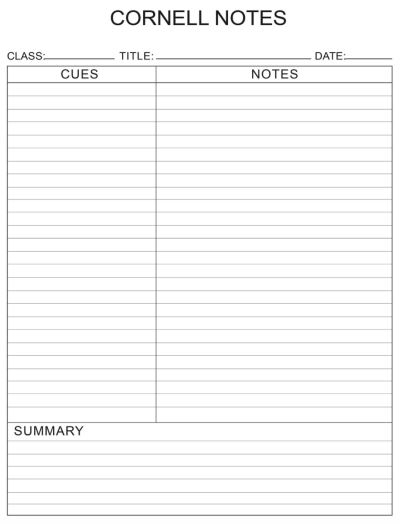
This structured approach divides your page into three distinct sections that work together to enhance learning and review. The notes column on the right is where you record lecture information during class, capturing key concepts, explanations, and examples.
The cue column on the left is completed after class, where you write questions, keywords, and recall prompts that correspond to the material in your notes column. The summary area at the bottom of the page is where you combine the main ideas after class, forcing you to articulate the core concepts in your own words.
This comprehensive method facilitates active recall during study sessions and makes reviewing more efficient by providing a built-in self-testing space through the cue column.
Mind Mapping
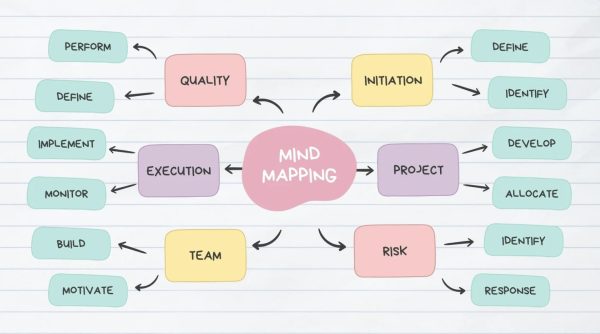
This visual technique starts with a central concept placed in the middle of the page and branches out to related ideas, creating an organic, non-linear representation of information.
Mind mapping is particularly beneficial for visual learners and courses with highly interconnected concepts where understanding relationships between ideas is as important as the ideas themselves.
The Outline Method
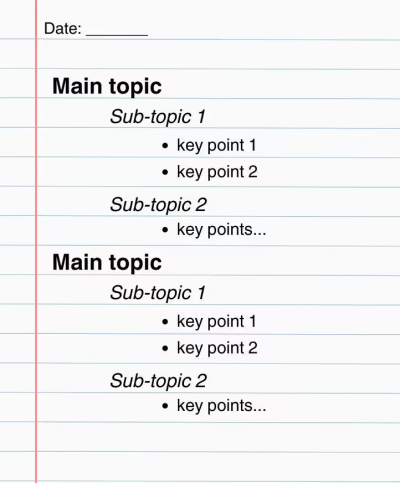
This traditional approach uses hierarchical organization to represent the relative importance of information and show how ideas relate to each other within a clear structure.
Main topics become Roman numerals (I, II, III), subtopics are designated by capital letters (A, B, C), and details are further broken down into numbers and lowercase letters. The outline method excels for well-structured lectures where professors present information in an organized, sequential manner.
It’s also ideal for creating reading notes from textbooks, which typically follow a hierarchical organization. This approach helps you understand how smaller concepts fit within broader themes, facilitating both detailed learning and comprehensive understanding.
Visual Note-Taking (Sketchnoting)
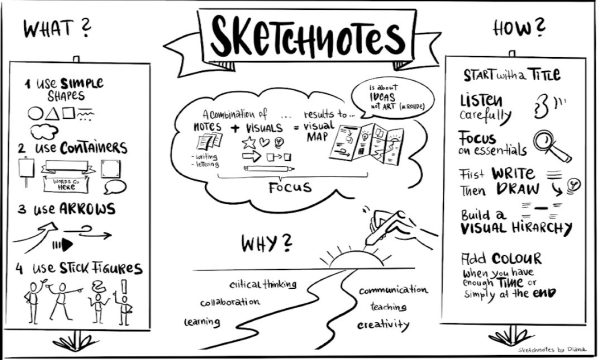
This creative approach incorporates drawings, symbols, and text to create a visually engaging information that leverages the brain’s preference for visual processing. Sketchnoting improves memory through visual associations, creating multiple pathways for recall beyond text alone.
It’s particularly effective for visual learners who process information better through images than words. Successful sketchnoting doesn’t require artistic skill — simple icons, basic diagrams, and visual structures suffice to create meaningful visual notes.