
I may earn a commission when you buy through links on the site at no extra cost to you. By using the links, you are helping support College EDC, and I genuinely appreciate your support.
The 5-Day Study Plan to Ace Your Midterms

Midterms season is approaching, and if you’re like most college students, you might be tempted to pull all-nighters and cram everything the day before your exams. But what if there was a better way—one backed by cognitive science and proven to not only improve your grades but also reduce your stress?
Enter the proven 5-day study plan, a strategic approach that transforms overwhelming course material into manageable chunks while leveraging how your brain actually learns and retains information.
The Science Behind Effective Studying
Before diving into the plan, let’s understand why it works. Research consistently shows that:
- Distributed practice (studying in short, spaced sessions) creates stronger neural pathways than cramming.
- Active recall (testing yourself) builds stronger memory connections than passive re-reading.
- Interleaving (mixing up topics) leads to better long-term retention than block studying.
This 5-day study plan incorporates these evidence-based principles to maximize your learning efficiency.
Step 1: Break Down Course Material
The foundation of this plan is dividing your exam material into four logical chunks. Here’s how:
- Review your syllabus, lecture notes, and textbook chapters.
- Group the material into four manageable chunks (A, B, C, D).
- For example:
- Chunk A: Chapters 1-2
- Chunk B: Chapter 3
- Chunk C: Chapters 4-5
- Chunk D: Chapter 6
This approach makes the material less overwhelming and creates a clear roadmap for your studying.
5-Day Study Plan Overview
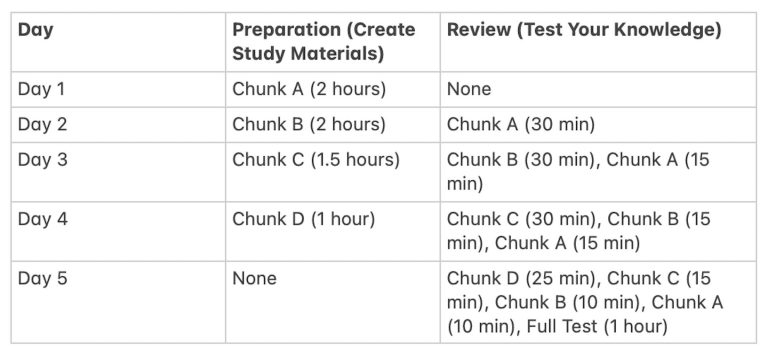
Notice how the plan gradually shifts from preparation to review, with each chunk being revisited multiple times — this is spaced repetition in action, which is one of the most effective study techniques for long-term retention.
Day-By-Day Breakdown
This is a breakdown of the midterm study plan, laid out step by step to ensure you’re fully prepared for each exam. You’ll mostly be studying in 25-minute intervals, followed by 5-minute breaks — this is called the Pomodoro technique, which helps improve focus, prevent burnout, and reduce procrastination.
Use these colors to organize your materials and schedule:
🔵 Blue: Chunk A
🟢 Green: Chunk B
🟠 Orange: Chunk C
🟣 Purple: Chunk D
Day 1: Laying the Foundation
🔵 Prepare Chunk A (2 hours)
- First Pomodoro Session (25+5+25+5 min)
- Create concept maps connecting key ideas
- Generate main questions this section answers
- Second Pomodoro Session (25+5+25 min)
- Create flashcards for key terms and formulas
- Generate practice questions for self-testing
Study Techniques:
- Use Feynman Technique: Write explanations as if teaching to someone else
- Create a one-page summary in your own words
- Identify connections to prior knowledge
End of Day Task:
- Organize Chunk A materials for review tomorrow
- Set 3 specific goals for tomorrow’s session
Day 2: Building Momentum
🟢 Prepare Chunk B (2 hours)
- First Pomodoro Session (25+5+25+5 min)
- Create study materials as in Day 1
- Identify connections between Chunks A and B
- Second Pomodoro Session (25+5+25 min)
- Complete preparation of Chunk B materials
- Identify potential test questions
🔵 Review Chunk A (30 minutes)
- One Pomodoro Session (25+5 min)
- Quiz yourself with flashcards (10 min)
- Blank page test: Write what you remember without looking (10 min)
- Identify and review weak areas (10 min)
End of Day Task:
- Organize materials for Day 3
- Note any questions to ask professors/TAs
Day 3: Deepening Knowledge
🟠 Prepare Chunk C (1.5 hours)
- First Pomodoro Session (25+5+25 min)
- Create study materials for Chunk C
- Connect concepts to Chunks A and B
- Second Pomodoro Session (25+5 min)
- Finish Chunk C preparation
- Create integrative questions across chunks
🟢 Review Chunk B (30 minutes)
- One Pomodoro Session (25+5 min)
- Active recall through flashcards (10 min)
- Explain key concepts out loud (Feynman) (15 min)
- Note difficult topics (5 min)
🔵 Review Chunk A (15 minutes)
- Quick flashcard review (5 min)
- Answer 2-3 practice questions (10 min)
End of Day Task:
- Address any weak areas from Chunk A
- Prepare questions for study group or office hours
Day 4: Expanding Coverage
🟣 Prepare Chunk D (1 hour)
- Two Pomodoro Sessions (25+5+25+5 min)
- Create study materials for Chunk D
- Identify connections to previous chunks
- Prepare integrated concept map across all material
🟠 Review Chunk C (30 minutes)
- One Pomodoro Session (25+5 min)
- Flashcard review (10 min)
- Explain concepts out loud (15 min)
- Note challenging areas (5 min)
🟢 Review Chunk B (15 minutes)
- Answer practice questions (10 min)
- Review difficult concepts (5 min)
🔵 Review Chunk A (15 minutes)
- Quick concept map review (5 min)
- Self-quiz on key points (10 min)
End of Day Task:
- Compile a list of challenging topics across all chunks
- Create a one-page “cheat sheet” summary of key formulas/concepts
Day 5: Final Review
🟣 Review Chunk D (25 minutes)
- Flashcard review (10 min)
- Explain difficult concepts (Feynman) (10 min)
- Connect to previous chunks (5 min)
🟠 Review Chunk C (15 minutes)
- Quick concept review (5 min)
- Answer practice questions (10 min)
🟢 Review Chunk B (10 minutes)
- Focus on any remaining weak areas
🔵 Review Chunk A (10 minutes)
- Final review of key concepts
Complete Practice Exam (1 hour)
- Take a comprehensive practice test covering all chunks
- Simulate exam conditions (no notes, timed)
- Review and identify any last-minute areas to address
End of Day Task:
- Organize materials for exam day
- Get a good night’s sleep!
Preparation Strategies That Actually Work
Here’s a few proven preparation strategies that will help you get the most out of the 5-day study plan and future study sessions going forward:
1. Create, Don't Just Review
Passive re-reading of notes is one of the least effective study methods. Instead, transform the notes you wrote in class into concept maps, practice questions, flashcards with key terms on them, or summary sheets in your own words.
2. Use the Feynman Technique
Named after Nobel Prize-winning physicist Richard Feynman, this technique involve choosing a concept and explaining it in simple language as if you’re teaching someone else. From there, you can identify gaps in your explanation, go back to source material to fill in those gaps, and simplify your explanation further.
3. Use Different Modalities
Boost your midterm success by engaging multiple learning pathways simultaneously. Visual learners should create mind maps and diagrams; auditory learners benefit from recordings and discussions; while kinesthetic learners thrive with physical flashcards and movement-based learning.
Click here for my guide of the 10 Most Effective Study Techniques for College Students.
Review Strategies (For Testing Knowledge)
The most effective techniques target how your brain actually stores and retrieves information. These complementary approaches don’t just help you memorize facts — they build the deep understanding and retrieval fluency that separate A students from the rest on exam day.
1. Active Recall Methods
Grab a blank page and write everything you remember about a topic without peeking at your materials. This practice forces your brain to retrieve information rather than simply recognize it.
Supplement with flashcards for quick concept checks, and solidify your understanding by teaching concepts to friends or even an imaginary audience. Complete practice questions that mimic exam conditions to build confidence and identify knowledge gaps before they cost you points.
2. Spaced Repetition
Instead of cramming, review material at strategic intervals (first after a day, then three days later, then a week) to allow your brain to strengthen neural pathways with each retrieval.
This method works because it targets the forgetting curve, focusing your limited study time on concepts you find challenging while spending less time on material you’ve already mastered. The result? Maximum retention with minimum time investment.
3. Interleaved Practice
Rather than studying all calculus problems at once, alternate between calculus, physics, and statistics to force your brain to discriminate between different problem-solving approaches.
This challenging practice builds flexible knowledge that better mimics real-world application and exam conditions, where questions aren’t neatly organized by concept as they often are in textbooks.
Digital Tools to Boost Your Study Plan
Leverage technology to make your study sessions more efficient. These are some of favorites, but there’s an endless amount of online tools you can utilize in college. Consider checking out my comprehensive guide of the 55 best digital tools for college students.
Notion
Create a dedicated workspace that breaks down each subject into manageable chunks (A-D), complete with daily study schedules and progress trackers that keep you accountable.
What makes Notion revolutionary is its flexibility — combine notes, to-do lists, and custom databases in one interface that adapts to your unique study style. The visual organization alone reduces anxiety by showing exactly what needs your attention each day.
Tomato Timer
Set this simple timer for 25-minute deep work sessions followed by 5-minute breaks to create a rhythm that sustains productivity without burnout.
This approach works because it aligns with your brain’s natural attention cycle, allowing you to maintain peak concentration during study blocks while scheduled breaks prevent mental fatigue. Students who implement this method often report completing more work in less time.
Anki
Master the forgetting curve with Anki’s intelligent flashcard system. Create separate decks for each content chunk and let the algorithm determine when you need to review specific cards — just before they would slip from memory.
Unlike traditional flashcards, Anki adapts to your performance, showing difficult cards more frequently while spacing out concepts you’ve mastered.
Quizlet
With Quizlet, you can quickly create study sets for each subject chunk, then leverage the various study modes to attack the material from different angles—matching exercises build recognition while test mode simulates exam pressure.
GoodNotes/Notability
These two note-taking apps allow you to create digital notebooks that transform scattered information into structured study resources. Create color-coded notebooks for each content chunk, easily annotate readings, and instantly search through mountains of lecture material.
The ability to switch between handwriting and typed text gives you the cognitive benefits of writing by hand with the searchability of digital text.
Knowt
With Knowt’s AI-powered study material generation, you can upload your lecture notes and watch as the app instantly creates customized flashcards and practice quizzes targeted to your specific course content.
This tool reduces the preparation phase of studying, allowing you to immediately dive into active recall practice.
Freedom
Enforce distraction-free studying by literally removing the option to procrastinate. Schedule blocked sessions that align perfectly with your 5-day study plan, preventing access to social media, news sites, and other digital rabbit holes.
By temporarily eliminating digital temptations, you create a workspace where deep focus becomes the path of least resistance.
GitMind
Visualize complex subject relationships with GitMind’s intuitive concept mapping tools. Build interactive diagrams that connect topics across your content chunks, transforming linear notes into a web of interconnected ideas.
This visual approach is particularly powerful for subjects with conceptual hierarchies or cause-effect relationships.
HeadSpace
Integrate strategic mental breaks with Headspace’s guided meditation sessions. Between intense study blocks, complete 5-10 minute mindfulness exercises designed to clear cognitive clutter and reset your attention.
This practice works by activating your parasympathetic nervous system, reducing stress hormones that impair memory.
Final Tips for Study Success
While the structured 5-day approach provides the framework for effective studying, your personal habits and environment significantly impact your success. The tips below address the often-overlooked factors that can make or break your midterm performance.
By optimizing your surroundings, managing your time effectively, maintaining your physical and mental wellbeing, and leveraging available support systems, you’ll create the ideal conditions for your brain to absorb and retain information.
1. Optimize Your Study Environment
- Find distraction-free study spots around campus.
- Have all your course materials ready before starting.
- Turn off notifications during study sessions.
2. Master Time Management
- Use the Pomodoro Technique consistently.
- Schedule study sessions at your peak energy times.
- Set specific, achievable goals for each session.
- Use a planner/calendar app to view all your deadlines, due dates, and meetings.
3. Prioritize Self-Care
- Stay hydrated throughout the day and eat brain-friendly foods at the dining and in your dorm.
- Take short walks between sessions.
- Get 7-8 hours of sleep each night — avoid long naps in the afternoon.
- Schedule brief mindfulness breaks.
- Connect with others: join clubs, socialize at student lounges, and attend campus events.
4. Leverage Available Resources
- Visit office hours with specific questions.
- Form study groups to discuss course material with classmates.
- Utilize campus academic support centers.